
 English
  Russian
 Digital hull
An accurate 3D model of the hull, sections and structural members for design verification and modernization prep.
Shipbuilding and ship repair
We digitize vessels, docks and production zones at 1:1 scale with laser scanning so design and repair teams work from as-built geometry rather than outdated drawings.
The approach is especially useful for large and hard-to-reach structures: hull, superstructures, engine rooms, piping, deck and dock areas.
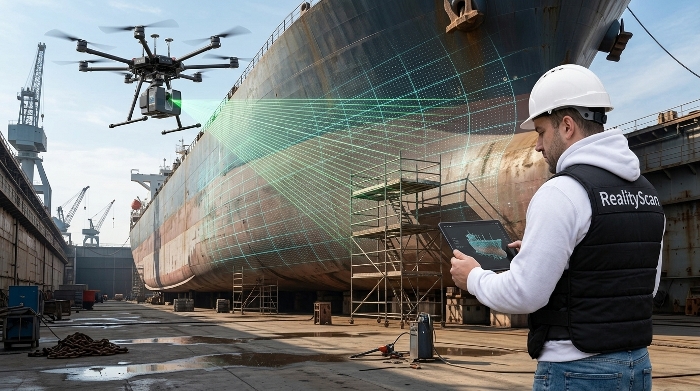
An accurate 3D model of the hull, sections and structural members for design verification and modernization prep.
Detection of displacements, deformations, corrosion zones and mismatches before cutting, welding and assembly.
Work and material quantities based on as-built geometry without repeat surveys and dock downtime.
A condition history of the vessel and yard for subsequent repairs, inspections and insurance procedures.
We combine terrestrial scanning, mobile routes and visual inspection to cover both open deck areas and dense interior spaces of the vessel.
We define survey zones, required accuracy and the target deliverable set for shipbuilding or repair tasks.
We digitize the hull, interior compartments, process routes and dock infrastructure.
We stitch scans, filter noise, align data and form a single coordinate model of the object.
We build a 3D/CAD/BIM model and compare it with design parameters to record discrepancies.
We prepare quantity takeoffs, operation sequencing and a data package for production execution.
We deliver the digital package to the client and update the archive for subsequent operations and modernization cycles.